Talibong: A Material Culture Study
DOI:
https://doi.org/10.65232/y8rhf728Keywords:
Bladesmith, Culture, Ethnography, Heirloom, Material Culture, Rituals, TalibongAbstract
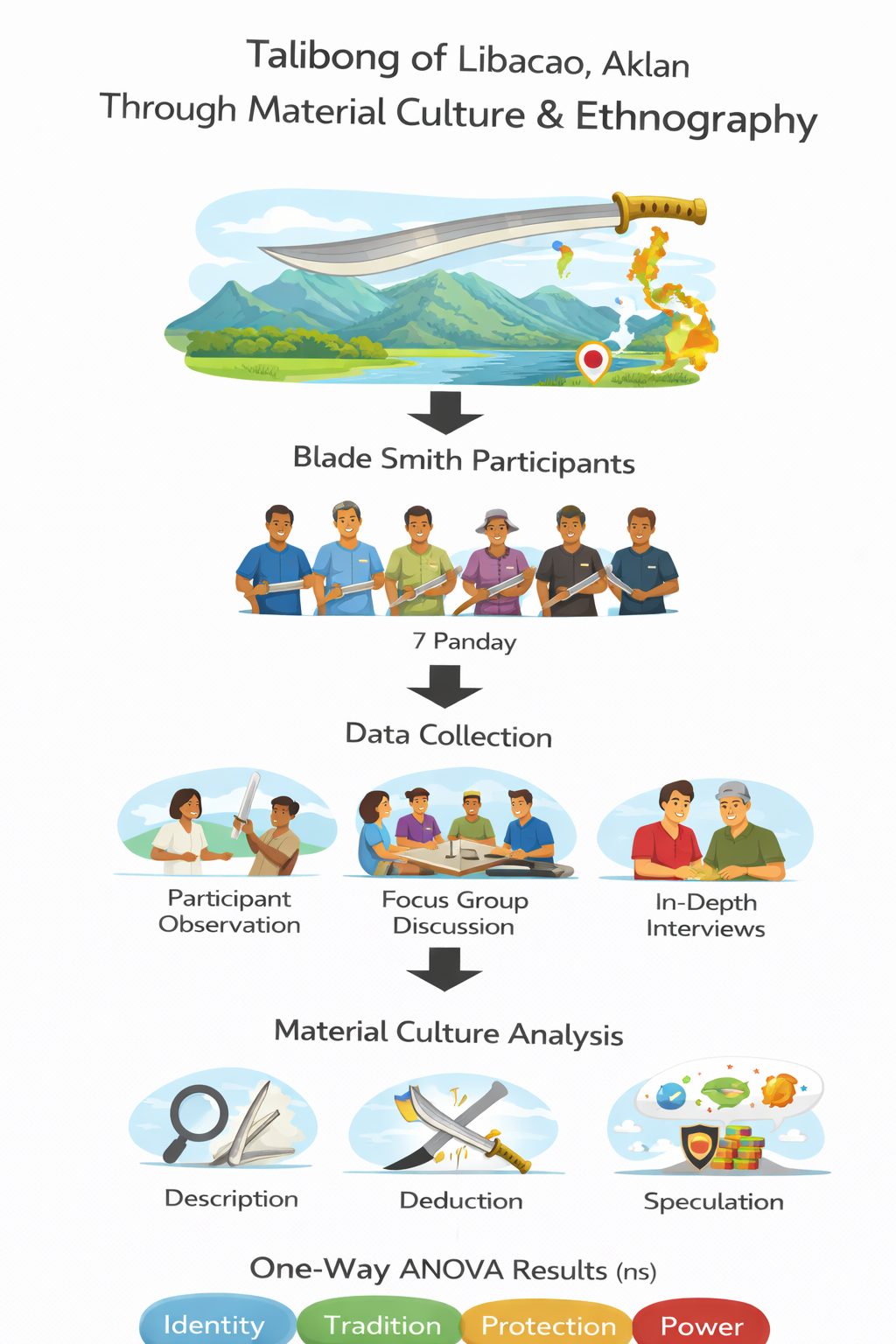
This qualitative study applied Material Culture study and Ethnography as research methodologies to describe and understand Talibong, an ancient sword, a material culture and identity of the people of Libacao, Aklan. This study was conducted in the remote town of Libacao in the Province of Aklan in the Philippines. This study has seven participants who are known locally as “panday” or blade smith and were identified to be making Talibong since they were young. The data collection strategies that were employed are participant observation, focus group discussion and in-depth interviews. Photographs and audio recordings were also used while gathering data. The set of data were analyzed using Jules Prown’s model of material culture analysis employing description, deduction and speculation. The findings of the study revealed that Talibong is an old age tradition practiced by the people of Libacao, Aklan. This has been culturally identified with the Libacaonons for centuries and it is an heirloom identified with the people. Rituals that are century old are practiced in the making of Talibong to ensure the safety of the blade smith while making it and protection to the owner of the Talibong. Talibong is a symbol of bravery, power and affluence.Talibong during the early times were made purposely for defense, a weapon for war. It is a material culture that is identified with the people of Libacao, Aklan, hence the expression of the locals: “ginaeagnat ru talibong kung indi kaeabu” (The Talibong gets sick when it could not slash).
Downloads
References
Ardales, V. B. (2001). Basic concepts and methods in research. Concerns Inc.
American Psychological Association. (2002). Ethical principles of psychologists and code of conduct. American Psychologist, 57(12), 1060–1073. https://doi.org/10.1037/0003-066X.57.12.1060
Badana, C., & Horlador, L. K. (2010). State of the bolo making industry in the municipality of Badiangan, Iloilo, Philippines. [Unpublished research paper]. University of the Philippines Visayas.
Berg, B. L., & Lune, H. (2011). Qualitative research methods for the social sciences (8th ed.). Pearson.
Bogdan, R., & Biklen, S. K. (2006). Qualitative research for education: An introduction to theories and methods (5th ed.). Allyn & Bacon.
Boski, P., Strus, K., & Tlaga, E. (2004). Cultural identity, existential anxiety and traditionalism. In B. N. Setiadi, A. Supratiknya, W. J. Lonner, & Y. H. Poortinga (Eds.), Ongoing themes in psychology and culture: Proceedings from the 16th International Congress of the International Association for Cross-Cultural Psychology. https://doi.org/10.4087/YWUT5806
Chevalier, M. (2012). The conservation and management of shared heritage: The prehistoric settlement of the Cuzco Valley, Peru. Archaeopress.
Creswell, J. W. (2014). Research design: Qualitative, quantitative, and mixed methods approaches (4th ed.). Thousand Oaks, CA: Sage.
Cultural Center of the Philippines (CCP). (1994). CCP encyclopedia of Philippine arts (Vol. 2). Quezon City: Cultural Center of the Philippines.
De Juan, R. (2009). The significance of the Talibong: A study of its cultural heritage. University of the Philippines Press.
Dela Cruz, J. (2011). The cultural identity of the people of Libacao, Aklan. National Bookstore.
Dela Cruz, J. (2014). The significance of Talibong in the cultural identity of Libacaonons. Aklan University Press.
D’Toole, B., & Were, G. (2017). Material culture and social identities. Journal of Anthropological Research, 73(2), 123–140.
Durkheim, E. (1999). The elementary forms of the religious life (D. Qu & Z. Ji, Trans.). Shanghai People’s Publishing House. (Original work published 1912)
Gell, A. (1992). The anthropology of time: Cultural constructions of temporal maps and images. Berg.
Glassie, H. (1999). Material culture. Indiana University Press.
Gomez, C. T. (1981). Cultural identity and academic achievements: The development of a cultural identity index for Filipino American students. http://rizalls.lib.admu.edu.ph:8080/proquestfil/8121624.pdf
Hoffman, M. (2003). Cultural heritage and identity. Oxford University Press.
Malinowski, B. (1948). Magic, science and religion and other essays. Anchor Books.
Prown, J. D. (1982). Mind in Matter: An Introduction to Material culture Theory and method. Winterthur Portfolio, 17(1), 1–19. https://doi.org/10.1086/496065
Prus, R. (1996). Symbolic interactionism and ethnographic research: Intersubjectivity and the study of human lived experiences. State University of New York Press.
Spradley, J. P., & McCurdy, D. W. (2012). Conformity and conflict: Readings in cultural anthropology. Pearson.
Strauss, A., & Corbin, J. (1990). Basics of qualitative research: Grounded theory procedures and techniques. Sage Publications, Inc.
Tutay, R. (1979). Libacao: A study of its people and culture. Ateneo de Manila University Press.
Woodward, K. (2007). Understanding material culture. Sage Publications. https://doi.org/10.4135/9781446278987
Additional Files
Published
Issue
Section
License
Copyright (c) 2025 Cherry Mae Teodosio (Author)

This work is licensed under a Creative Commons Attribution 4.0 International License.
Articles in the APCORE Online Journal (AOJ) are published under the Creative Commons Attribution 4.0 International License (CC BY 4.0). Authors retain copyright and grant the journal the right of first publication, allowing others to share and adapt the work with proper attribution to the original author and source.
https://creativecommons.org/licenses/by/4.0/