The Impact of the Therapeutic Community Modality Program (TCMP) on Re-Offender Rate Among Person Deprived of Liberty (PDL) in Lucena City District Jail Female Dormitory, Quezon Province
DOI:
https://doi.org/10.65232/mxvwgy36Keywords:
Therapeutic Community Modality Program, Behavioral Rehabilitation, Re-offender Rate, Female Persons Deprived of Liberty (PDLs), Reintegration Framework, Lucena City District JailAbstract
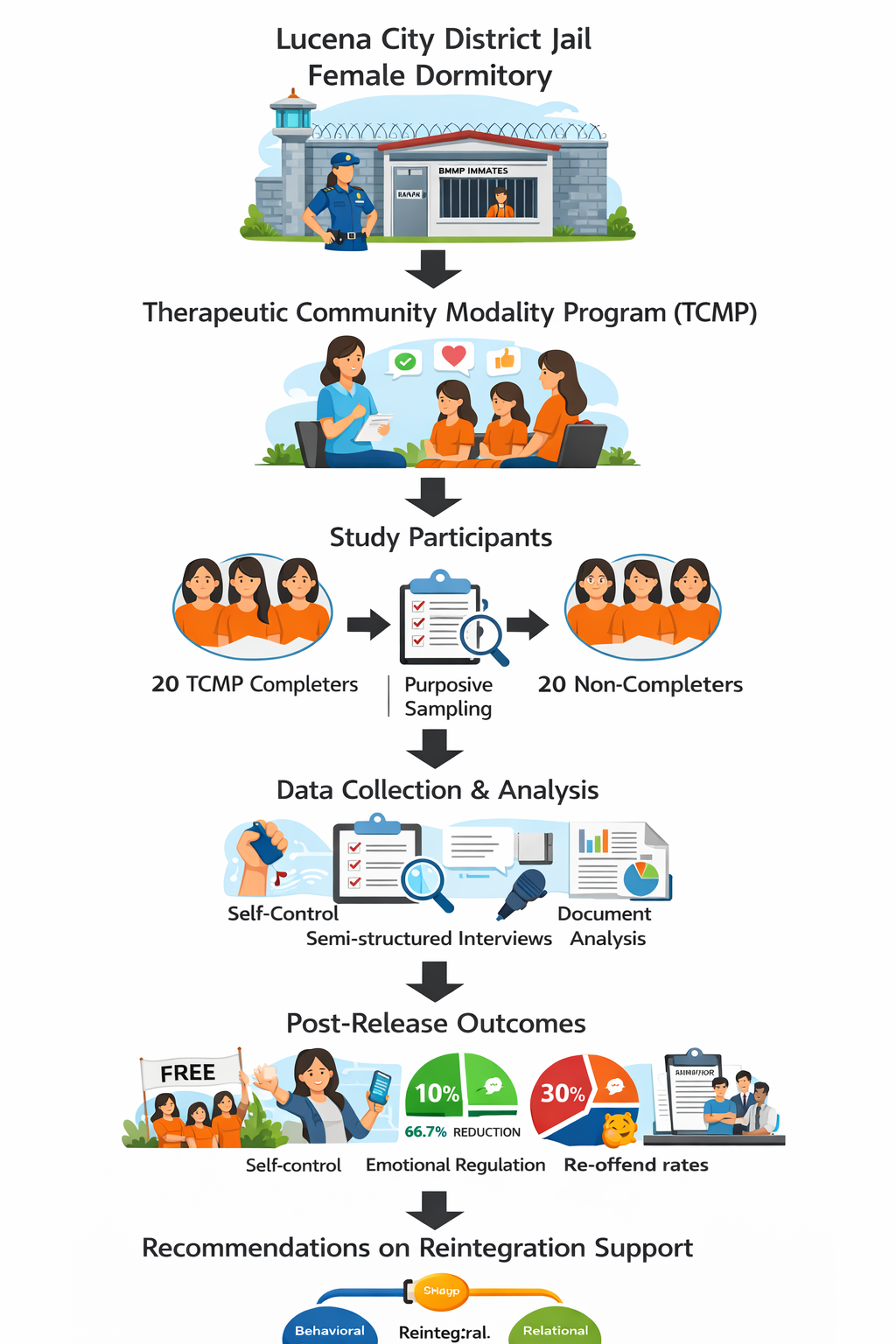
This study evaluated the impact of the Therapeutic Community Modality Program (TCMP) on post-release behavior and recidivism among female Persons Deprived of Liberty (PDLs) in the Lucena City District Jail Female Dormitory, Quezon Province. It specifically examined the program’s influence on behavioral rehabilitation during incarceration—covering personal behavior, attitudes, and decision-making—and tracked post-release outcomes. Using purposive sampling, the study involved 40 former female PDLs (20 TCMP completers and 20 non-completers) released between 2022 and 2024. Participants’ post-release status was monitored for 12 months after discharge. Data were gathered through a researcher-made questionnaire, semi-structured interviews, and document analysis. Quantitative data were analyzed using descriptive statistics, t-tests, and chi-square tests, while qualitative data were subjected to thematic analysis. Findings showed that TCMP completers demonstrated marked improvements in self-control, emotional regulation, and decision-making discipline. The re-offender rate among completers (10%) was notably lower than among non-completers (30%), representing a 66.7% reduction in recidivism associated with program completion. The study also introduced the Therapeutic Community Modality Program–Based Reintegration Support Framework (TRSF), emphasizing four interrelated domains—Behavioral Continuity, Relational Support, Socioeconomic Empowerment, and Community Linkages—as foundations for sustained rehabilitation. Overall, the results affirm that the TCMP contributes significantly to behavioral transformation and reduced re-offending among female PDLs. The study recommends the program’s continued expansion, institutionalized post-release monitoring, and stronger interagency collaboration among the Bureau of Jail Management and Penology (BJMP), local government units, and community organizations to enhance long-term reintegration outcomes.
Downloads
References
Aguilar, J., Santos, M., & Reyes, L. (2021). Evaluating rehabilitation programs for persons deprived of liberty: A case study of select Philippine jails. Asian Journal of Criminology, 16(4), 287-302. https://doi.org/10.1007/s11417-021-09352-7
APCORE Online Journal Volume 1 Issue 1, (2024), “Gender and Justice: Rehabilitative Models in Southeast Asian Correctional Systems” https://doi.org/10.65232/4141jx89
Bandura, A. (1977). Social Learning Theory. Prentice-Hall.
Berg, M. T., & Huebner, B. M. (2022). Reentry and recidivism: A multi-level analysis of reentry outcomes. Journal of Criminal Justice, 81, 101930. https://doi.org/10.1016/j.jcrimjus.2022.101930
Bureau of Jail Management and Penology. (2023). BJMP Annual Report 2023: Advancing Rehabilitation and Community Reintegration. BJMP National Headquarters.
Bureau of Jail Management and Penology. (2023). Therapeutic Community Modality Program (TCMP) Operations Manual. BJMP Directorate for Reformation, National Headquarters.
Caravaca-Sánchez, F., & García-Jarillo, M. (2022). Factors associated with behavioral change among incarcerated women: A longitudinal study. Journal of Criminal Justice, 82, 101936. https://doi.org/10.1016/j.jcrimjus.2022.101936
Clark, V. A., & Duwe, G. (2023). Post-release reentry programs: An analysis of effectiveness and timing. Criminal Justice Policy Review, 34(2), 151–176. https://doi.org/10.1177/08874034221125075
DeLisi, M., Berg, M. T., & Hochstetler, A. (2022). Reentry and recidivism: The roles of social bonds, interventions, and offender decision- making. Justice Quarterly,39(1),84105. https://doi.org/10.1080/07418825.2020.1852330
Department of Justice. (2022). Restorative Justice Programs in the Philippines: Status Report and Future Directions. Department of Justice, Republic of the Philippines.
Duwe, G., & Kim, K. (2022). The impact of correctional programming on post-release recidivism: A longitudinal analysis. Justice Quarterly, 39(4), 647–670. https://doi.org/10.1080/07418825.2020.1859874
García, M. E., & Ortega, R. F. (2022). Building recovery capital in prison-based therapeutic communities: A qualitative exploration. Journal of Offender Rehabilitation,61(2), 91–109. https://doi.org/10.1080/10509674.2021.2010038
Guevara, M. A., Cruz, C. V., & Salazar, M. E. (2023). Gendered pathways to desistance: post-release challenges and opportunities for female ex- inmates in the Philippines. International Journal of Offender Therapy and Comparative Criminology, 67(6-7), 693–712. https://doi.org/10.1177/0306624X221101231
Hlavka, H. R., Wheelock, D., & Cossyleon, J. E. (2023). Women, reintegration, and the gendered barriers to desistance. Feminist Criminology, 18(2), 179–199. https://doi.org/10.1177/15570851221133198
Holtfreter, K., & Wattanaporn, K. A. (2023). Effects of therapeutic communities on offender outcomes: A longitudinal analysis. Crime & Delinquency, 69(3), 393–418. https://doi.org/10.1177/00111287211013540
Johnson, P. J., Lobo, R., & Smith, D. (2022). Cognitive restructuring and emotional regulation in inmate behavioral rehabilitation. Journal of Offender Rehabilitation, 61(3),210228 . https://doi.org/10.1080/10509674.2021.2012314
Listwan, S. J., Sullivan, C. J., & Cullen, F. T. (2022). Reconsidering rehabilitation: Examining the impact of treatment programs on recidivism. Crime & Delinquency, 68(3),410–438. https://doi.org/10.1177/0011128721992047
Martin, J., Stermac, L., & Servidio, R. (2022). The role of peer interaction in prison-based therapeutic community programs. International Journal of Offender Therapy and Comparative Criminology, 66(5),487–504. https://doi.org/10.1177/0306624X211042239
Matos, F. R., & Marques, L. (2024). Behavioral transformation through education and therapy among prisoners: A mixed-methods analysis. European Journal of Criminology, 21(1), 45–67. https://doi.org/10.1177/14773708231114565
O'Connell, D. J., Visher, C. A., & Winterfield, L. (2023). Gender-responsive interventions and recidivism outcomes among female offenders. Criminal Justice and Behavior, 50(2), 194–216. https://doi.org/10.1177/00938548221119362
Pratt, T. C., & Turanovic, J. J. (2023). Rehabilitation and recidivism: A meta- analytic review of correctional programs. Journal of Research in Crime and Delinquency, 60(1), 3–33. https://doi.org/10.1177/00224278221091365
Ramirez, D. S., Lim, R. T., & Almonte, J. B. (2023). Rehabilitative impacts of therapeutic community programs in Philippine jails: A case study analysis. Asian Journal of Criminology, 18(1), 63–84. https://doi.org/10.1007/s11417-022-09379-2
Reyes, A. L., Lim, V. P., & Concepcion, S. T. (2025). Promoting resilience and behavioral change among incarcerated women through structured rehabilitation. Philippine Journal of Penology and Criminology, 12(1), 33–55.
Santos, A. G., & De Guzman, M. A. (2024). Gender-responsive therapeutic communities in Philippine correctional facilities: A program evaluation. Philippine Journal of Criminology and Penology, 10(1), 45– 66.
Seim, J., & Harding, D. J. (2024). Reentry and social inequality: Reimagining reintegration frameworks. Sociology of Crime, Law and Deviance, 29,41–62. https://doi.org/10.1108/S1521-613620240000029003
Shukla, R., & Mansoor, H. (2023). Enhancing behavioral outcomes in Southeast Asian correctional facilities: A therapeutic intervention study. Asian Journalof Criminology, 18(2), 157–179. https://doi.org/10.1007/s11417-022-09384-5
Visher, C. A., & Lattimore, P. K. (2022). Role of family support in prisoner reentry success. Journal of Offender Rehabilitation, 61(6), 407–428. https://doi.org/10.1080/10509674.2022.2070425
Zeng, Z., Blomberg, T. G., & Bales, W. D. (2022). Prisoner rehabilitation programs and recidivism: An analysis of long-term outcomes. The Prison Journal, 102(1), 25–50. https://doi.org/10.1177/00328855211058491
Additional Files
Published
Issue
Section
License
Copyright (c) 2025 Jessica Marquez (Author)

This work is licensed under a Creative Commons Attribution 4.0 International License.
Articles in the APCORE Online Journal (AOJ) are published under the Creative Commons Attribution 4.0 International License (CC BY 4.0). Authors retain copyright and grant the journal the right of first publication, allowing others to share and adapt the work with proper attribution to the original author and source.
https://creativecommons.org/licenses/by/4.0/