The Impact of Laboratory Facilities Availability on Criminology Licensure Examination Performance at St. Anne College Lucena, Inc.
DOI:
https://doi.org/10.65232/pkxk7d90Keywords:
Laboratory Facilities, Criminology Licensure Examination (CLE), Student PerformanceAbstract
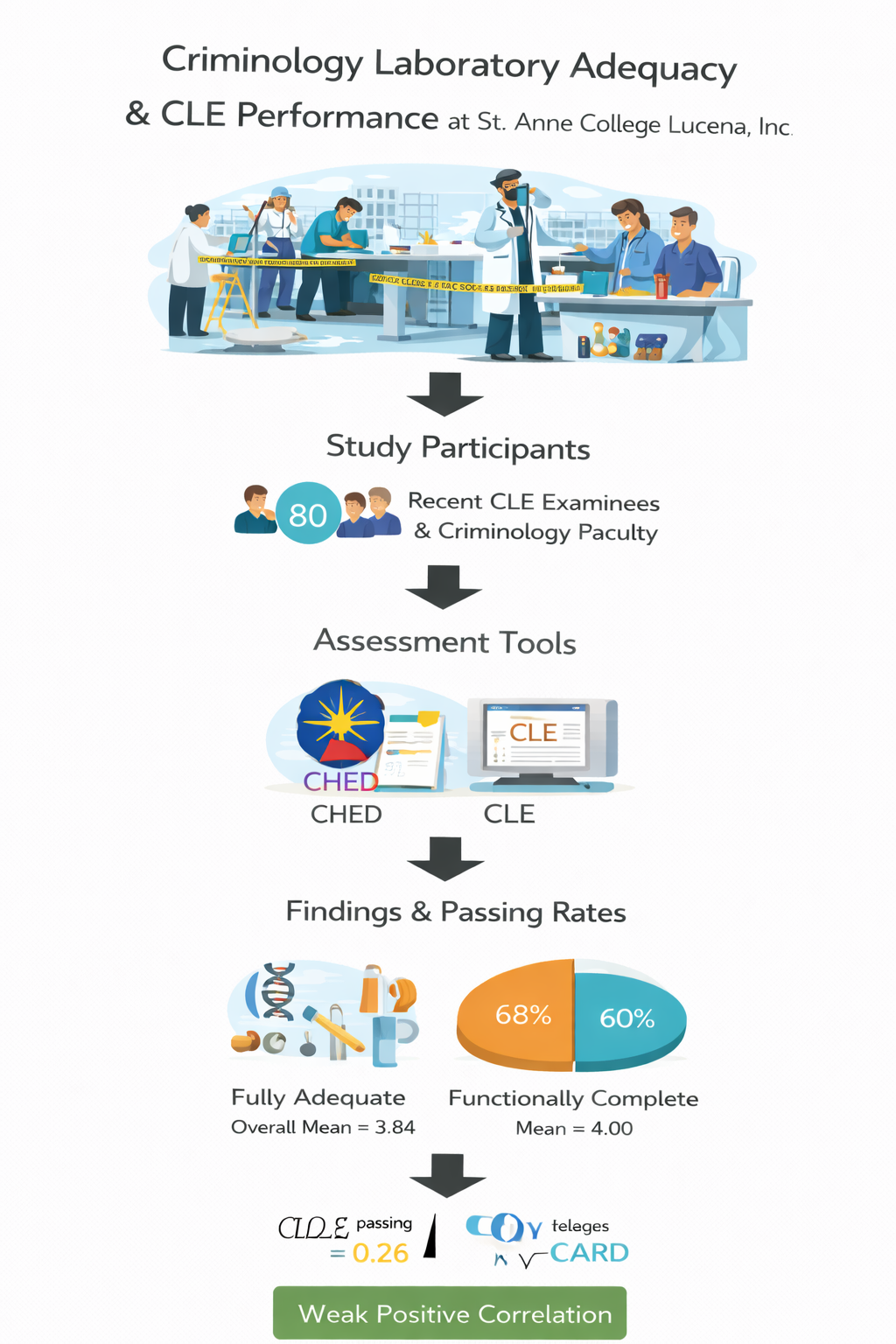
This study examined the relationship between the adequacy of criminology laboratory facilities and Criminology Licensure Examination (CLE) performance at St. Anne College Lucena, Inc. Researchers collected data from 80 respondents, using a descriptive-correlational design composed of recent CLE examinees and criminology faculty members. CHED-aligned evaluation tools assessed laboratory adequacy; institutional CLE results provided performance data. Results showed that laboratory facilities were rated fully adequate (overall weighted mean = 3.84) and functionally complete (mean = 4.00). Pearson’s r analysis revealed a weak but positive correlation between laboratory adequacy and CLE performance (r = 0.26). The CLE passing rate of first-time takers (68%) was notably higher than that of repeaters (42%). Qualitative findings highlighted that laboratory use strengthened theoretical understanding, practical skills, and exam confidence. The study concludes that while adequate facilities support improved performance, other factors such as review integration and targeted support for repeaters remain critical. It recommends modernizing laboratory equipment, aligning simulations with CLE competencies, and embedding lab-based review exercises to enhance licensure outcomes.
Downloads
References
Alharbi, A., Nurfianti, A., Mullen, R. F., McClure, J. D., & Miller, W. H. (2024). The Effectiveness of Simulation-Based Learning on Students’ Knowledge and Skills in Nursing Programs: A Systematic Review. BMC Medical Education, 24, 1099. https://doi.org/10.1186/s12909-024-06080-z
Bracewell, T. E., & Jones, C. (2022). The Use of Simulated Crime Scenes in Teaching Undergraduate Forensic Sciences: Implementing an Active Learning Approach to Forensics. Science & Justice, 62(6), 758‑767. https://doi.org/10.1016/j.scijus.2022.08.003
Caingcoy, M. (2022). Relationship Between School Facilities and Performance of Education Graduates in the Licensure Examination. International Journal of Multidisciplinary: Applied Business and Education Research, 3(10), 1895–1907. https://doi.org/10.11594/ijmaber.03.10.11
Camal, H. J. (2022). Quality Assurance Assessment of the Criminology Program of Basilan State College. International Journal of Multidisciplinary Research and Publications, 5(5), 141–145. https://ijmrap.com/wp-content/uploads/2022/11/IJMRAP-V5N5P100Y22.pdf
Commission on Higher Education. (2005). CHED Memorandum Order No. 21, series of 2005: Criminal Justice Education: Policies and Standards for the Criminology Program. https://www.scribd.com/doc/251999570/CMO-No-21-s2005
Creswell, J. W. (2014). Research design: Qualitative, Quantitative, and Mixed Methods Approaches (4th ed.). SAGE Publications.
Dula, M. D., & Lagumen, H. (2018). Impact of Laboratory Facilities on the Development of Competencies of Criminology Students in Criminalistics: Basis for the Development of Proposed Instructional Framework in Teaching Criminalistics Courses. Enverga University Research. https://mseuf.edu.ph/research/read/738
Kolb, D. A. (1984). Experiential Learning: Experience as the Source of Learning and Development. Prentice-Hall. https://pubmed.ncbi.nlm.nih.gov/38478822/
Libres, A. C., & Dalman, J. T. (2025). Assessment of the Adequacy and Quality of Laboratory Facilities and its Impact on Students’ Academic Achievements. Liceo Journal of Higher Education Research. https://asianscientificjournal.com/new/publication/index.php/ljher/article/view/1532/2167
Limon, M. R. (2023). The Effect of The Adequacy of School Facilities on Students’ Performance and Achievement in Technology and Livelihood Education. International Journal of Academic Research in Progressive Education and Development, 5(1). http://dx.doi.org/10.6007/IJARPED/v5-i1/2060
Miranda-Rodríguez, R. A., & Sánchez-Nieto, J. M. (2024). Effectiveness of Intervention Programs in Reducing Plagiarism by University Students: A Systematic Review. Frontiers in Education, 9, Article 1357853. https://doi.org/10.3389/feduc.2024.1357853
Mulleta, D., Jaleta, F., Banti, H., Bekele, B., Abebe, W., Tadesse, L., Eshetu, L., Zewdu, A., Botore, A., & Tadesse, L. (2021). The Impact of Laboratory Quality Management System Implementation on Quality Laboratory Service Delivery in Health Center Laboratories of Oromia Region, Ethiopia. PLM International Journal of Quality in Health Care, https://doi.org/10.2147/PLMI.S314656
Nilendu, D. (2024). Enhancing Forensic Education: Exploring the Importance and Implementation of Evidence-Based Education System. Egyptian Journal of Forensic Sciences, 14(1), Article 6. https://doi.org/10.1186/s41935-023-00375-w
Patalinghug, M. E., Morrok, A. P., Gilaga, B. G. (2023). Criminal Justice Education Quality Assurance and Program Standard: Implications from a Document Analysis of SUCs Evaluation Reports. Jurnal Pendidikan Progresif, 13(2), 493–507. http://dx.doi.org/10.23960/jpp.v13.i2.202326
Professional Regulation Commission (PRC). (2023). Licensure Examination Performance Report for Criminologists.
Additional Files
Published
Issue
Section
License
Copyright (c) 2025 Leonardo Ella (Author)

This work is licensed under a Creative Commons Attribution 4.0 International License.
Articles in the APCORE Online Journal (AOJ) are published under the Creative Commons Attribution 4.0 International License (CC BY 4.0). Authors retain copyright and grant the journal the right of first publication, allowing others to share and adapt the work with proper attribution to the original author and source.
https://creativecommons.org/licenses/by/4.0/