Level of Implementation in the Deployment of Pre-Service Teachers on Experiential Learning Courses in the National Capital Region: Basis for Proposed Enhanced Policy Implementation
DOI:
https://doi.org/10.65232/me4at916Keywords:
Assessment, Implementation, Deployment, Pre-Service Teachers, Experiential Learning CoursesAbstract
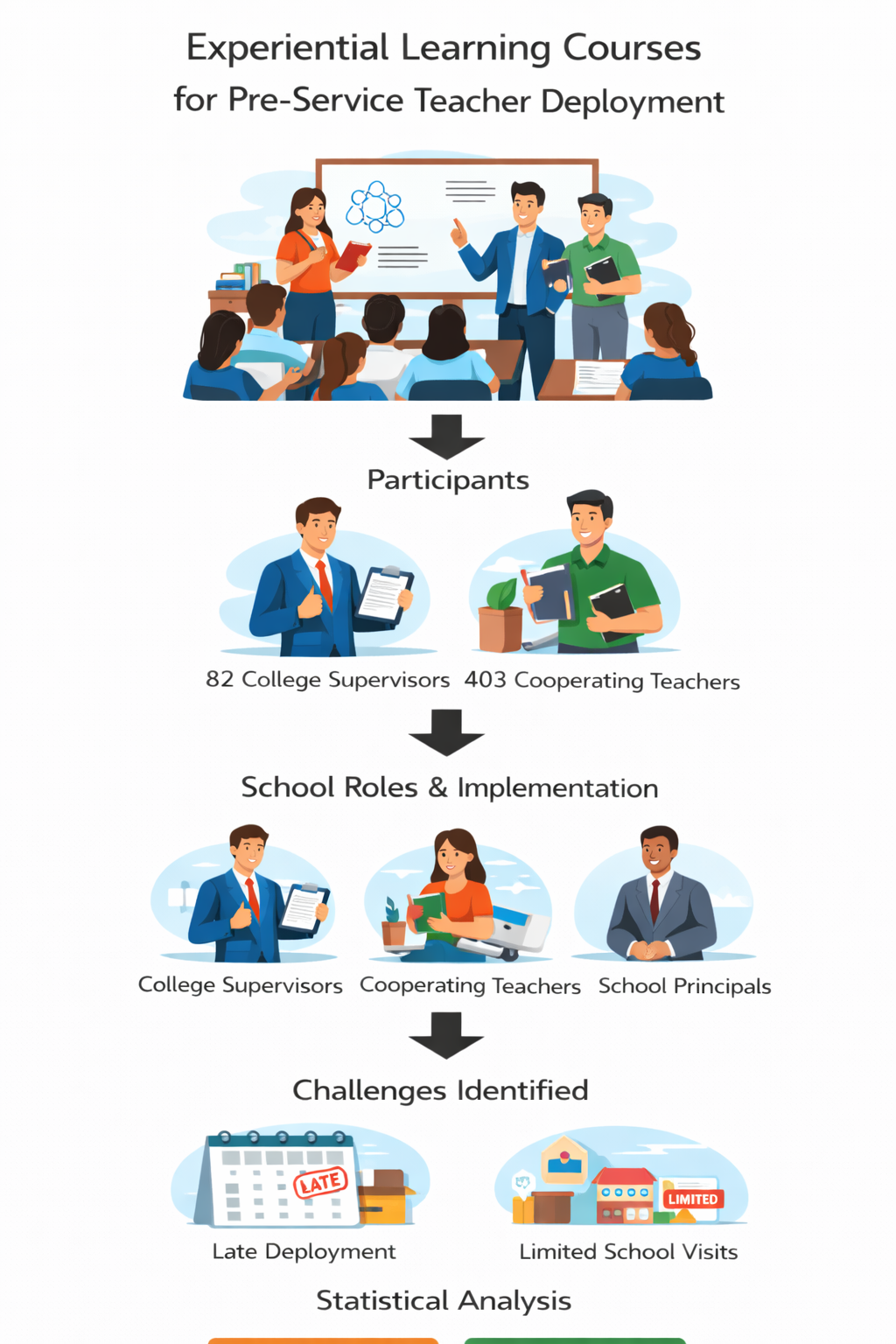
Pre-service teacher training is a critical stage in teacher education that enables pre-service teachers to immerse themselves in an authentic school setting by integrating theoretical knowledge with actual classroom practice. This study examined the perceptions of 82 college supervisors from Teacher Education Institutions and 403 cooperating teachers from the Department of Education in the National Capital Region regarding the implementation of Experiential Learning Courses (ELCs). Using a quantitative design with proportionate and multi-stage sampling, data were collected through two validated and reliability-tested questionnaires. Descriptive statistics were used to assess how well the ELCs were implemented, while nonparametric tests such as the Mann-Whitney U test and the Kruskal-Wallis H test were used to determine significant differences in perceptions among respondent groups. Findings revealed that the roles of college supervisors, cooperating teachers, and school principals in the deployment of pre-service teachers were generally rated as highly implemented. Significant differences were noted in the supervisors’ assessments of the roles of deans, and in cooperating teachers’ evaluations of school principals and their respective roles. The primary challenges identified by the respondents during deployment included the late deployment of pre-service teachers and limited school visits by supervisors. These findings recommend the need for stronger coordination between institutions and schools to optimize experiential learning opportunities. Furthermore, the Teacher Education Institutions should develop deployment schedules aligned with the DepEd school calendar and consider providing logistical support for college supervisors to enhance ELC monitoring.
Downloads
References
Addison, A. W. (2010). A study of the effects of the length of student-teaching experiences on new teacher efficacy [Doctoral dissertation, East Tennessee State University]. Digital Commons @ East Tennessee State University. https://dc.etsu.edu/cgi/viewcontent.cgi?article=3107&context=etd
Algazor, G. (2017). The role of teaching practice in teacher education programs: Designing framework for best practice. Global Journal of Educational Research, 16(2), 101-110. https://dx.doi.org/10.4314/gjedr.v16i2.4
Ambag, S. C. (2015). Assessment of competency level of pre-service teachers based on National Competency-Based Teacher Standards (NCBTS) in public school in the National Capital Region (NCR). European Academic Research, 2(11), 14060–14078.
Araya, H. (2013). The practice and challenges of practicum Implementation program at teacher education college, Tigray region [Master's thesis, Addis Ababa University]. AAU Institutional Repository. https://etd.aau.edu.et/items/baeb62b4-f51d-42e9-bc04-6ae736538156
Badion, H.S., Abolencia, C.N.S., Abolencia, I.N.S., Pastor, E.E., & Carillo, C.D. (2016). The implementation of field study courses in Eastern Visayas University, International Journal on Lifelong Education and Leadership, 2(1) 26-35
Bilbao, P. B., Torno, B. G., & Lucido, P. I. (2010). Enhancement of teacher competencies through experiential learning courses: Implications to the pre-service teacher education curriculum. CNU Journal of Higher Education, 4(1), 117-138. https://doi.org/10.70997/2546-1796.1066
Borabo, M. L. (2018). Teaching Internship. Lorimar Publishing.
Calicdan, A. (2017). Implementation of the practice teaching program of the Pangasinan State University. Southeast Asian Journal of Science and Technology, 2(1), 12–16. https://sajst.org/online/index.php/sajst/article/download/16/15
Castro, F.A & Tayao, J. S. (2011). Implementation of the field study courses in public schools. Harvest: Institutional Research Publication of Baliuag University, 7(1). https://ejournals.ph/article.php?id=1963
Commission on Higher Education. (2004). CHED Memorandum Order No. 30, series of 2004: Revised policies and standards for undergraduate teacher education curriculum. https://ched.gov.ph/wp-content/uploads/2017/10/CMO-No.30-s2004.pdf
Damar, E. A. (2010). Cooperating teachers' awareness about their role during the teaching practice course: The Turkish context. E-Journal of New World Sciences Academy 6(1), 54-65. https://dergipark.org.tr/tr/download/article-file/185610
Darling-Hammond, L. (2017). Teacher education around the world: What can we learn from international practice? European Journal of Teacher Education, 40(3), 291–309. https://doi.org/10.1080/02619768.2017.1315399
Department of Education. (2007). DepEd Order No. 3, series 2007. Guidelines in the deployment of pre-service teachers on experiential learning: Field study and practice teaching. https://www.deped.gov.ph/2007/01/24/do-3-s-2007-guidelines-in-the-deployment-of-pre-service-teachers-on-experiential-learning-field-study-and-practice-teaching/ Eyers, V. (2004). Guidelines for quality in the practicum. National Institute for Quality Teaching and School Leadership, Australia.
Flores, M. (2016). Practice teaching: Revisiting student teachers’ performances. The Confluence, 7(2), 0. https://ejournals.ph/article.php?id=10356
Guevarra, P. M. (2005). Performance of cooperating teachers in selected technological institutions. [Unpublished master’s thesis]. Technological University of the Philippines, Manila.
Kendall, A., & Trang, N. T. T. (2023). New insights for practice education: teacher education in Vietnam. PRACTICE, 5(3), 181–183. https://doi.org/10.1080/25783858.2024.2413298
Latifah, D. (2014). The role of in-service teacher in supervising pre-service teachers during teaching practicum program. Journal of Arts Research and Education 14(2), 88-96.
https://doi.org/10.15294/harmonia.v14i2.3290.
Leviste, J.V. (2004). Development of the action plan for enhancing student teachers competencies. [Master’s thesis]. Philippine Normal University.
Mangila, B. B. (2018). Assessment of pre-service teachers on the practice teaching program: Inputs for program enhancement. Asia Pacific Journal of Education, Arts and Sciences, 5(3), 50-58. https://doi.org/10.26803/ijlter.18.10.18
Melesse, T. (2014). Assessment on the implementation of the pre-service practicum program in teacher education colleges: Dessi college of teacher education in focus. Journal of Education and Practice, 5(20), 97-110. https://www.iiste.org/Journals/index.php/JEP/article/view/14251
Meneses,J. L., Alvarez, J. J., Olympia, R.J. G., James, F. C., Tiamzon, D.T., Ong, A. Y. (2017). Performances of pre-service teachers in their practice teaching and field study courses. Liceo Journal of Higher Education Research, 3(1), 109-124. http://dx.doi.org/10.7828/ljher.v13i1.1011
Organisation for Economic Co-operation and Development. (2019). Education Policy Outlook 2019: Working Together to Help Students Achieve their Potential. OECD Publishing. https://doi.org/10.1787/2b8ad56e-en
Patan, J. P. (2010). Implementation of field study courses in the pre-service teacher education program in selected higher education institutions in Caraga. JPAIR Multidisciplinary Journal, 5(1), 1-1. http://dx.doi.org/10.7719/jpair.v5i1.121
Payant, C., & Murphy, J. (2012). Cooperating Teachers’ Roles and Responsibilities in a MATESOL Practicum. TESL Canada Journal, 29(2), 1. https://doi.org/10.18806/tesl.v29i2.1097
Somblingo, R. (2010). Extended practicum in teacher education institutions in Zamboanga City: Status, problems and pre-service teachers’ competencies. Western Mindanao State University Research Journal, Volume 29(2), 35-53.
Russell, T. (2006). Educational partnership and challenges of educational reform. In P. Aubusson & S. Schuck (Eds.), Teacher learning and development (pp. 83–95). Springer. https://doi.org/10.1007/978-1-4020-4642-1_5
Tuli, F., & File G. (2010). Practicum experience in teacher education. The Ethiopian Journal of Education and Sciences, 5(1), 107-116. https://doi.org/10.4314/ejesc.v5i1.56311
United Nations Educational, Scientific and Cultural Organization. (2015). Teachers in Asia Pacific: Status and Rights. UNESCO Bangkok Office. https://unesdoc.unesco.org/ark:/48223/pf0000234756
Ulla, M. B. (2016). Pre-service teacher training programs in the Philippines: the student-teachers’ practicum experience. EFL Journal, 1(3), 235-250. http://dx.doi.org/10.21462/eflj.v1i3.23
Walelign, T. and Fantahun, M. (2007). Assessment on problems of the new pre-service teacher’s training program. The Ethiopian Journal of Education and Sciences, 2(2). https://doi.org/10.4314/ejesc.v2i2.41980
Yacap, M.J. (2022). Experiential learning courses’ implementation in teacher education institutions in the Philippines. International Academic Journal of Education and Literature, 3(2), 60-70. https://doi.org/10.47310/iajel.2022.v03i02.007
Additional Files
Published
Issue
Section
License
Copyright (c) 2025 Sherry Ann Medrano-Bacolod (Author)

This work is licensed under a Creative Commons Attribution 4.0 International License.
Articles in the APCORE Online Journal (AOJ) are published under the Creative Commons Attribution 4.0 International License (CC BY 4.0). Authors retain copyright and grant the journal the right of first publication, allowing others to share and adapt the work with proper attribution to the original author and source.
https://creativecommons.org/licenses/by/4.0/