Police Work at Lucena City Port: Gaps, Solutions, and Paths Forward
DOI:
https://doi.org/10.65232/8qebzp29Keywords:
Challenges, Current Roles, Port Police Personnel, Port Police Training Manual, Public Safety, Institutional Support SystemAbstract
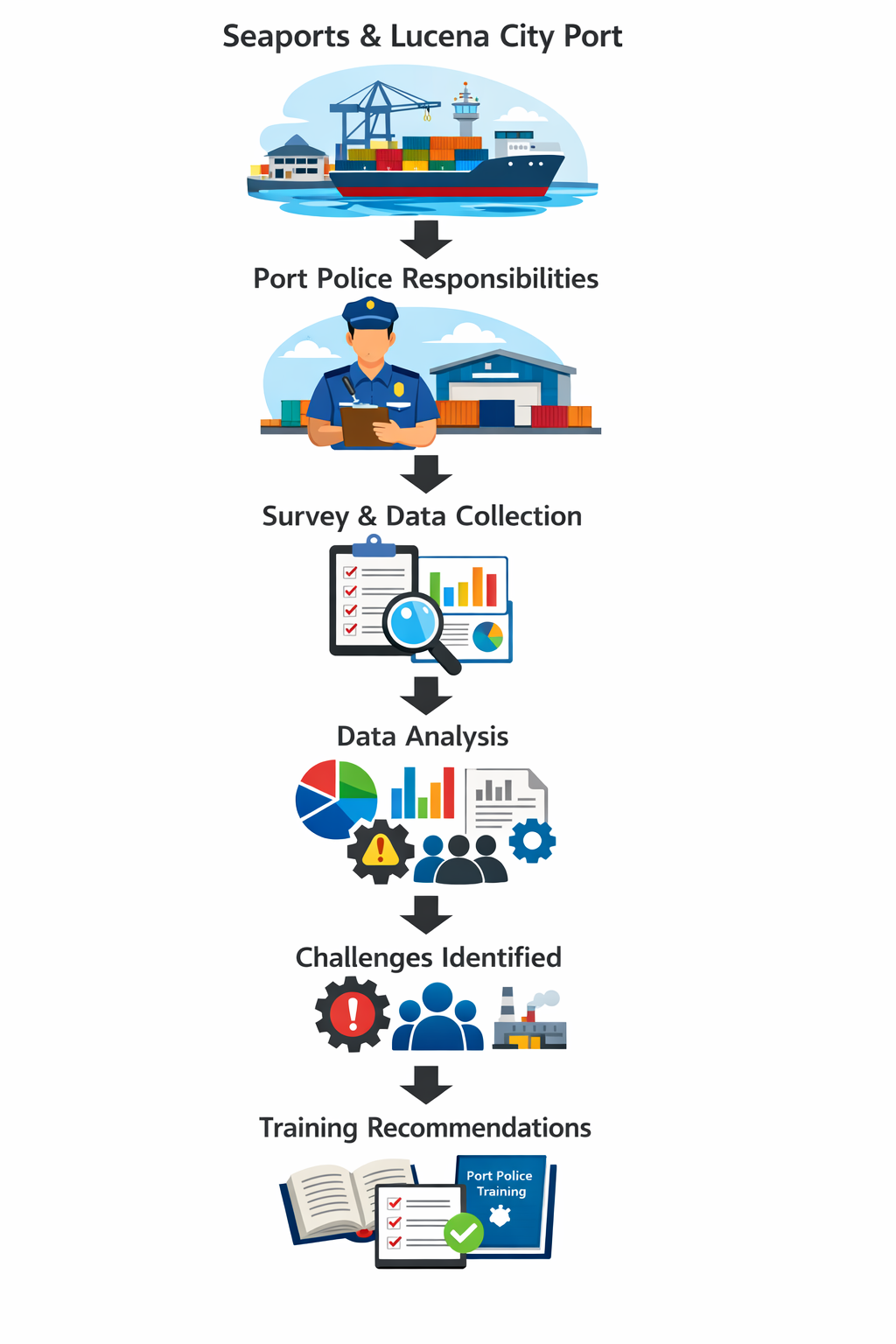
Seaports play a crucial role in facilitating global trade, supporting economic growth, and ensuring national security. The study aims to systematically evaluate the degree to which Philippine Ports Authority police personnel fulfill their assigned regulatory roles and identify the operational, organizational, and environmental challenges they encounter. The Philippine Ports Authority plays a critical role in managing and securing public ports across the country, including Lucena City Port. The Lucena City Port police personnel, as part of this operational framework, are tasked with upholding rules and regulations to maintain order within the port premises, ensure safe movement of goods and passengers, and safeguard the integrity of port facilities. This study analyzed the current roles and challenges of Port Police Authority police personnel in Lucena City Port to provide an empirical foundation for enhancing their training and professional development and to develop an improved and contextualized Port Police Training Manual. This study employed a descriptive quantitative research design, the design was selected to allow the researcher to systematically describe and quantify the responses of the participants without manipulating any variables, as defined by Creswell, descriptive research enabled the accurate portrayal of characteristics of a given population, particularly in relation to observed behaviors and perceptions. The researcher recommends the Philippine Ports Authority should institutionalize targeted training modules for Philippine Ports Authority police personnel, must strengthen institutional support systems and adopt and integrate the five evidence-based training components developed in this study into its existing Port Police Training Manual.
Downloads
References
Chen, S.-L., et al. (2017). Maintaining and researching port safety: A case study of the Port of Kaohsiung. European Transport Research Review, 9(28). https://doi.org/10.1007/s12544-017-0250-z
Climate Change and Security Impact Assessment. (2022). NATO. https://empresaclima.org/wp-content/uploads/2022/09/1_Climate-Change-Security-Impact-Assessment.pdf
Creswell, J. W. (2014). Research design: Qualitative, quantitative, and mixed methods approach (4th ed.). SAGE Publications. https://www.academia.edu/57201640/Creswell_J_W_2014_Research_Design_Qualitative_Quantitative_and_Mixed_Methods_Approaches_4th_ed_Thousand_Oaks_CA_Sage
Crime, corruption, maritime insecurity and the environment: why a criminal justice approach is necessary to protect our oceans. (n.d.-b). United Nations: Office on Drugs and Crime. https://www.unodc.org/unodc/frontpage/2022/August/crime--corruption--maritime-insecurity-and-the-environment_-why-a-criminal-justice-approach-is-necessary-to-protect-our-oceans.html
Docor, J. V. D., Lago III, F. Y., Macayran, A. D., Allanic, E. A., & Cuevas Jr., J. F. (2023). Duties and Responsibilities: Experiences of Port Security Personnel. International Journal of Research and Innovation in Social Science, 7(6), 896-902. https://ideas.repec.org/a/bcp/journl/v7y2023i6p896-902.html
Eski, Y. (2015). The port securityscape: an ethnography. PhD thesis, University of Glasgow. https://theses.gla.ac.uk/6296/2/2015EskiPhD.pdf
Ponio, G., Rashed, Y., van Hassel, E., & Verhoeven, P. (2022). Modelling regulatory capture in the port sector: A case study in the Philippines. Case Studies on Transport Policy, 10(2). 1005-1014 https://doi.org/10.1016/j.cstp.2022.03.014
Sergi, R., Storti, L., & Easton, M. (2021). Ports, Crime and Security: Governing and Policing Seaports in a Changing World. Policy Press. https://www.jstor.org/stable/j.ctv1rnpjf6
PPA Annual Report. (2023). Philippine Ports Authority. https://www.ppa.com.ph/sites/default/files/annual_report/PPA_Annual_Report_2023_0.pdf
Richards, F. (2022). Efficient Port Security Operation Trends and Challenges. https://portalcip.org/wp-content/uploads/2022/09/Franklyn-Richards-Final-Efficient-Port-Security-Operation-Trends-and-Challenges5.pdf
Hoogesteyn, K., Hofer M., Taniguchi T., & Rineer J. (2025). Addressing police turnover: Challenges, strategies, and future research directions. RTI Press. https://www.rti.org/rti-press-publication/addressing-police-turnover-challenges-strategies-future-research-directions/fulltext.pdf
Philippine Ports Authority. (1995). PPA Administrative Order No. 10-95: Guidelines on the revocation/cancellation of contract/permit for cargo handling services or Cargo Handling Contract Recall (CHCR). Supreme Court E-Library. https://elibrary.judiciary.gov.ph/thebookshelf/showdocs/10/44779
PPA Operations Memorandum Circular No. 001-2024. (2024). Philippine Ports Authority. https://ppa.com.ph/sites/default/files/issuances_docs/PPA-OMC_No_001_2024.pdf
Redevelopment of Dalahican Port in Lucena, Quezon Province. (2023). Unpublished undergraduate/ graduate thesis. [Manuel S Enverga University Foundation]
The Study of Man : Linton, Ralph : Free download, borrow, and streaming : Internet Archive. (1936). Internet Archive. https://archive.org/details/studyofman031904mbp/page/60/mode/2up
Additional Files
Published
Issue
Section
License
Copyright (c) 2025 Angelie De Castro (Author)

This work is licensed under a Creative Commons Attribution 4.0 International License.
Articles in the APCORE Online Journal (AOJ) are published under the Creative Commons Attribution 4.0 International License (CC BY 4.0). Authors retain copyright and grant the journal the right of first publication, allowing others to share and adapt the work with proper attribution to the original author and source.
https://creativecommons.org/licenses/by/4.0/