Digital Competence of Teachers and the Academic Performance of Students in Tertiary Education
DOI:
https://doi.org/10.65232/7v8vqb67Keywords:
Digital Competence, Technological Skills, Pedagogical Integration, Academic PerformanceAbstract
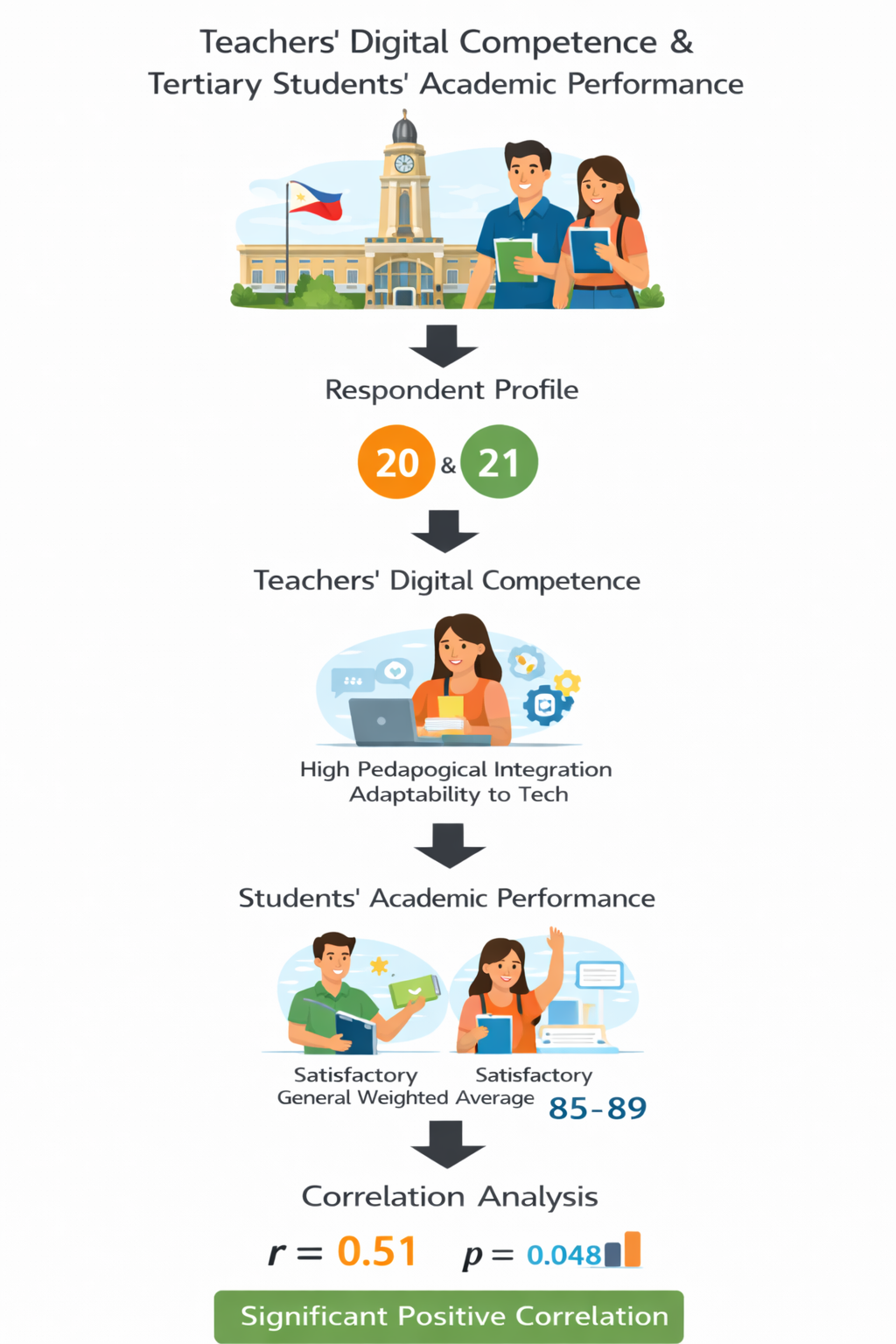
This study is quantitative research that employed a descriptive-correlational design to determine the digital competence of teachers and the academic performance of selected tertiary-level students of a local university in Manila City, Philippines. The study revealed that most respondents were 20 to 21 years old. Teachers were perceived to possess high levels of digital competence, particularly in pedagogical integration and adaptability to new technologies. Students generally demonstrated satisfactory academic performance, with most achieving a general weighted average between 85 and 89. Findings showed no significant difference in academic performance when grouped by age (p=0.34) and gender (p=0.28). However, a moderate, positive, and significant correlation was found between digital competence of teachers and academic performance of students (r=0.51, p=0.048), indicating that teachers' digital skills positively influence students' learning outcomes and academic success. The study recommends strengthening teachers' digital competence through continuous professional development focused on meaningful technology integration and adaptable instructional strategies. Higher education institutions should invest in robust digital infrastructure, provide structured training based on established frameworks such as TPACK and DigCompEdu, and promote collaborative innovation to ensure exclusive and equitable technology use. Policymakers are urged to support sustained digital transformation by allocating resources for training and access, establishing national standards, and aligning initiatives with workforce demands. Future research should examine the long-term impacts of digital competence and the role of emerging technologies in enhancing learning outcomes.
Downloads
References
Abildina, S., Sardarova, Z., Ozgambayeva, R., Janzakova, S., Kalykbayeva, A., Bitikova, A., & Abdol, E. (2023). The effect of variables associated with the digital learning environment on students’ motivation and attitudes. International Journal of Education in Mathematics, Science and Technology, 11(6), 1497–1517. https://doi.org/10.46328/ijemst.3781
Basilotta-Gomez-Pablos, V., Matarranz, M., Casado-Aranda, L. A., & Otto, A. (2022). Teachers’ digital competencies in higher education: A systematic literature review. International Journal of Educational Technology in Higher Education, 19, 8. https://doi.org/10.1186/s41239-021-00312-8
Cabero-Almenara, J., Gutiérrez-Castillo, J., Barroso-Osuna, J., & Rodriguez-Palacios, A. (2023). Digital teaching competence according to the DigCompEdu framework. Comparative study in different Latin American Universities. Journal of New Approaches in Educational Research, 12(2), 276-291. https://doi.org/10.7821/naer.2023.7.1452
Garcia-Peñalvo, F.J., Corell, A., Abella-Garcia, V., Grande-de-Prado, M. (2021). Recommendations for mandatory online assessment in higher education during the COVID-19 pandemic. Lecture Notes in Educational Technology. Springer, Singapore. https://doi.org/10.1007/978-981-15-7869-4_6
Lai, Y., Saab, N., & Admiraal, W. (2022). University students’ use of mobile technology in self-directed language learning: Using the integrative model of behavior prediction. Computers and Education, 179, 104413. https://doi.org/10.1016/j.compedu.2021.104413
Loureiro, A. C., Santos, A. I., & Meirinhos, M. (2024). Digital competence for pedagogical integration: A study with elementary school teachers in the Azores. Education Sciences, 14(12), 1293. https://doi.org/10.3390/educsci14121293
Martens, W., & Pham, D. T. H. (2025). Academic Achievement in a Digital Age: Intersections of Support and Systems. Social Sciences, 14(9), 513. https://doi.org/10.3390/socsci14090513
Mishra, P., & Koehler, M. J. (2006). Technological pedagogical content knowledge: A framework for teacher knowledge. Teachers College Record: The Voice of Scholarship in Education, 108(6), 1017-1054. https://doi.org/10.1111/j.1467-9620.2006.00684.x
Mosquera-Gende, I. (2023). Digital tools and active learning in an online university: Improving the academic performance of future teachers. Journal of Technology and Science Education, 13(3), 632–645. https://doi.org/10.3926/jotse.2084
Redecker, C. (2017). European framework for the digital competence of educators: DigCompEdu (Y. Punie, Ed.; EUR 28775 EN). Publications Office of the European Union. https://doi.org/10.2760/159770
UNESCO. (2018). ICT competency framework for teachers (ICT-CFT) (3rd ed.). UNESCO. https://teachertaskforce.org/sites/default/files/2020-07/ict_framework.pdf
Yang, L., Garcia-Holgado, A., & Martínez-Abad, F. (2023). Digital competence of K-12 pre-service and in-service teachers in China: A systematic literature review. Asia Pacific Education Review, 24, 679–693. https://doi.org/10.1007/s12564-023-09888-4
Additional Files
Published
Issue
Section
License
Copyright (c) 2025 Dr. Ricardo C. Reyes III (Author)

This work is licensed under a Creative Commons Attribution 4.0 International License.
Articles in the APCORE Online Journal (AOJ) are published under the Creative Commons Attribution 4.0 International License (CC BY 4.0). Authors retain copyright and grant the journal the right of first publication, allowing others to share and adapt the work with proper attribution to the original author and source.
https://creativecommons.org/licenses/by/4.0/