The Influence of Aeta Traditional Healing Practices on Tourism Development in San Felipe, Zambales: A Phenomenological Study
DOI:
https://doi.org/10.65232/bsq8qv87Keywords:
Aeta, Cultural Tourism, Indigenous Knowledge, Phenomenology, Sustainable Development, Traditional HealingAbstract
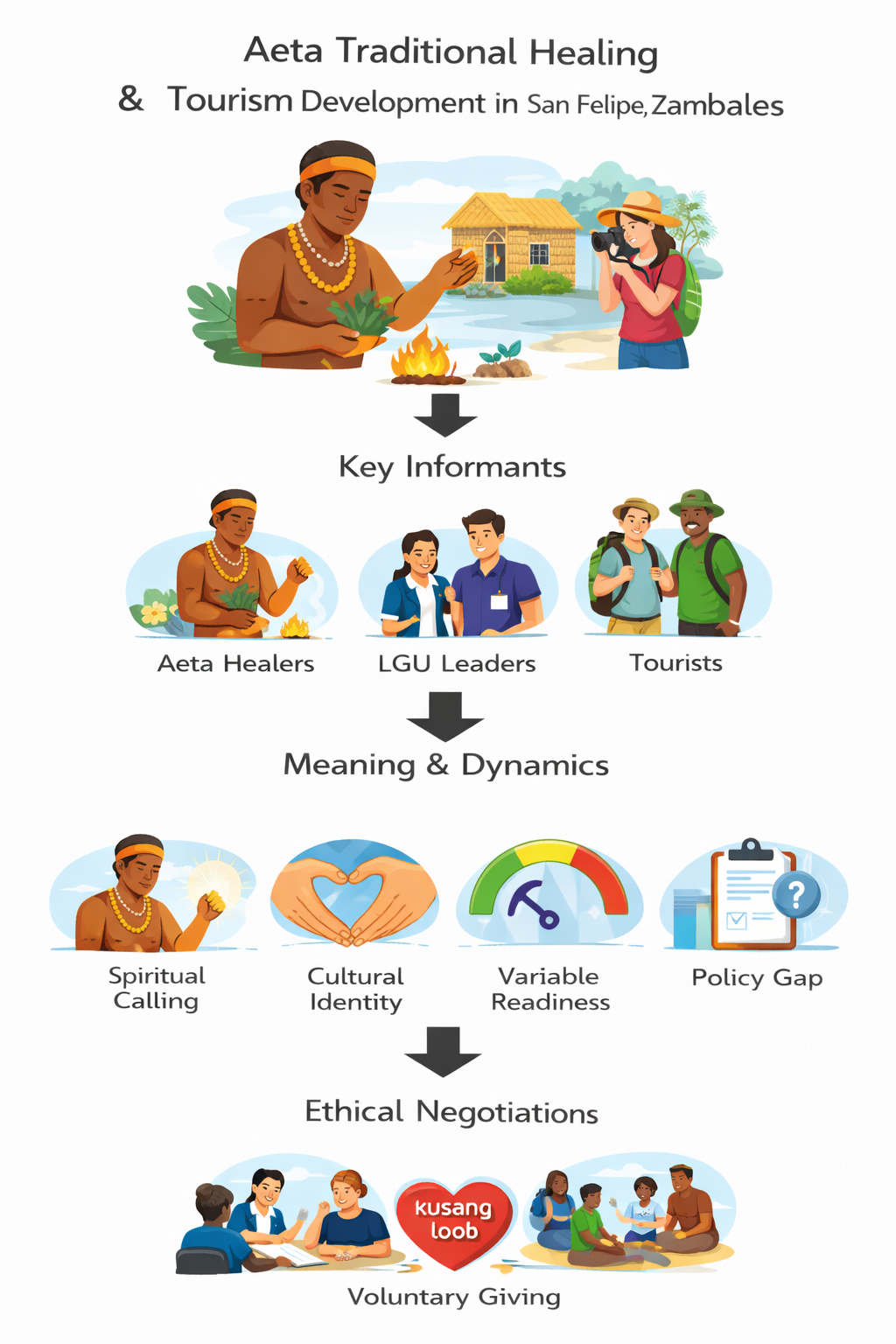
Cultural tourism worldwide places indigenous communities at an important paradox between creating economic advantages and challenging the commodification of intangible cultural heritage. This interplay was explored through the effect of Aeta traditional healing on tourism development in San Felipe, Zambales. There is limited scholarly knowledge about the subtle, human qualities of the actors involved. This phenomenological study was conducted to investigate the meaning of such lived experiences. Data were gathered through in-depth, semi-structured interviews with ten purposively selected key informants (Aeta healers, LGU leaders, tourists). Thematic analysis revealed that Aeta healing is not merely a practice but a profound spiritual calling and a cornerstone of cultural identity. However, its intersection with tourism is shaped by multifaceted dynamics, a broad spectrum of readiness among healers, a critical knowledge and policy gap within the LGU, and a community-wide ethical negotiation to prevent exploitation, embodied by the principle of kusang loob (voluntary giving). The study concludes that sustainable integration requires a co-created, empathetic framework that prioritizes cultural sovereignty and ensures the Aeta are the definitive agents of tourism development centered on their heritage.
Downloads
References
Andalan, J. R., Mondejar, A. J. S., Sumaya, N. H. N., et al. (2024). Ethnobotanical survey of medicinal and ritual plants utilized by the indigenous communities of Benguet province, Philippines. Tropical Medicine and Health, 52, 59. https://doi.org/10.1186/s41182-024-00624-1
Angeles, J. K. D., & Angeles, X. M. (2024). Perceptions of young members of the Aeta community about their intellectual property rights for their traditional knowledge systems: Uniquely Magbukun. Asia-Pacific Intellectual Property Management and Innovation Book Series (No. 1). https://animorepository.dlsu.edu.ph/apipmibookseries/1
Braun, V., & Clarke, V. (2006). Using thematic analysis in psychology. Qualitative Research in Psychology, 3(2), 77–101. https://doi.org/10.1191/1478088706qp063oa
Canet, L. N. (2025). Cultural heritage and traditional medicine: A cartography of healing practices. Journal of Rural Tourism, 4(2). https://doi.org/10.70310/jrt.2025.04021269
Creswell, J. W., & Poth, C. N. (2023). Qualitative inquiry and research design: Choosing among five approaches (5th ed.). SAGE Publications.
David, N. D. (2021). School of Living Traditions on Aeta Magbukún indigenous knowledge: Promoting indigenous food plants for food security. Humanities, Arts and Social Sciences Studies, 21(3), 518-534. https://doi.org/10.14456/hasss.2021.47
GMA News. (2024). How the Aeta communities of San Felipe, Zambales came together to reforest their ancestral land. GMA News Online. https://www.gmanetwork.com/news/scitech/content/914673/how-the-aeta-communities-of-san-felipe-zambales-came-together-to-reforest-their-ancestral-land/story/
Gutierrez, E. L. M. (2019). Participation in tourism: Cases on community-based tourism in the Philippines. Ritsumeikan Journal of Asia Pacific Studies, 37(1), 23–38. https://doi.org/10.34409/rjaps.37.1_23
Madrid, M. (2024). Multi-stakeholder analysis on tourism development in Zambales, Philippines. American Journal of Economics and Business Innovation, 3(1), 21–35. https://doi.org/10.54536/ajebi.v3i2.262
Martinez, R. C. K. (2019). The health ritual of “Pag aanito” among the Aetas of Nabuclod, Pampanga, Philippines. Journal of Humanities and Cultural Studies, 1(1), 41-47.
Rahmadian, E., Feitosa, D., & Zwitter, A. (2021). A systematic literature review on the use of big data for sustainable tourism. Current Issues in Tourism, 25(11), 1711-1730. https://doi.org/10.1080/13683500.2021.1974358
Smith, L. T. (2021). Decolonizing methodologies: Research and Indigenous peoples (3rd ed.) Bloomsbury Academic & Zed Books.
Teves, R. I. M., Tantengco, O. A. G., Sumatra, R. J. U., Carag, H. M., & Isidro-Lapeña, J. S. (2023). Ethnomedicinal survey of valuable plants used by Eskaya traditional healers in Bohol Island, Philippines. Acta Medica Philippina, 57(3). https://doi.org/10.47895/amp.vi0.3883
UNESCO. (2023). Convention for the Safeguarding of the Intangible Cultural Heritage. https://ich.unesco.org/en/convention
Additional Files
Published
Issue
Section
License
Copyright (c) 2025 Dr. Renald Jay O. Fio, Natalie S. Dela Torre, Princess Debbie A. Francisco, Maribeth S. Gonzales, Loraine R. Ledesma, Carlyn Joy C. Malu-Ay, Elmarie D. Bersabal (Author)

This work is licensed under a Creative Commons Attribution 4.0 International License.
Articles in the APCORE Online Journal (AOJ) are published under the Creative Commons Attribution 4.0 International License (CC BY 4.0). Authors retain copyright and grant the journal the right of first publication, allowing others to share and adapt the work with proper attribution to the original author and source.
https://creativecommons.org/licenses/by/4.0/