The Use of Generative AI in Clinical Learning Activities and Its Relationship on Student Nurses’ Caring Practices
DOI:
https://doi.org/10.65232/q07jhb10Keywords:
Caring Practices, Clinical Learning Activities, Generative Artificial Intelligence, Holistic Care, Nursing Education, Student NursesAbstract
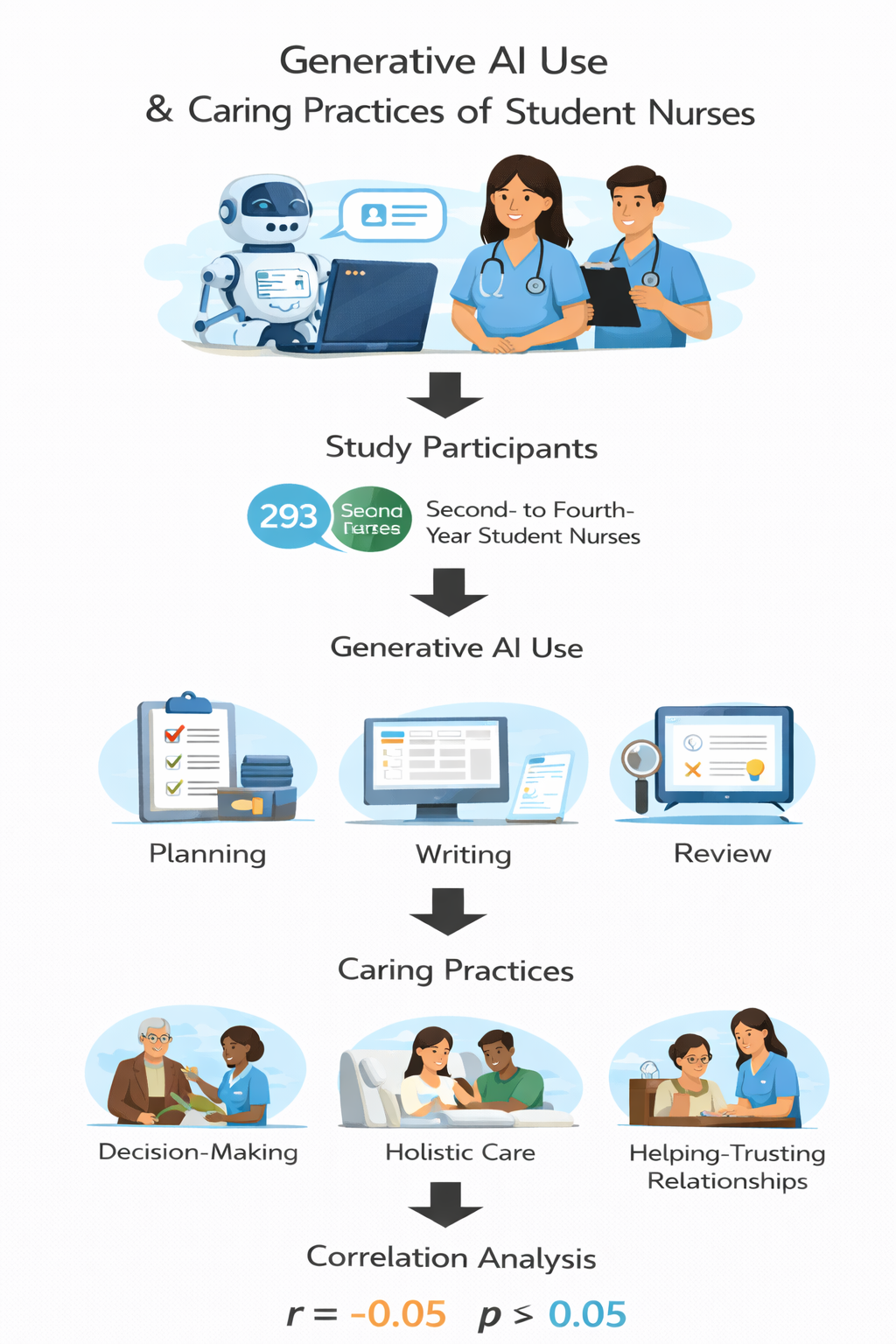
This study examined the relationship between the use of Generative Artificial Intelligence (Generative AI) in clinical learning activities and the caring practices of student nurses. Guided by Watson’s Theory of Human Caring, the research investigated caring behaviors across decision-making, holistic care, and helping-trusting relationships among 293 second- to fourth-year nursing students at Wesleyan University-Philippines during Academic Year 2024-2025. Using a quantitative descriptive-correlational design and stratified purposive sampling, the study included only students who had completed at least one semester of Related Learning Experience and had prior exposure to Generative AI for academic and clinical tasks. Data were gathered through a researcher-developed questionnaire with validated subscales, including an adapted Caring Behaviors Inventory (Cronbach’s α = 0.86 in the full dataset). Descriptive statistics showed that student nurses “often” used Generative AI across planning, writing, and review tasks, while caring practices remained consistently “high” across all measured domains. Assumption testing using Shapiro-Wilk confirmed that composite scores were approximately normally distributed, permitting the use of Pearson’s r to analyze relationships between variables. Correlation results revealed no significant associations (p > 0.05) between the frequency of Generative AI use and caring practices, indicating that increased AI use did not predict changes in humanistic nursing behaviors. Uniformly high scores across caring dimensions also suggested potential ceiling effects, warranting cautious interpretation of nonsignificant results. The study concludes that while Generative AI supports academic tasks, it does not diminish core caring values among student nurses and highlights the need for ethical, balanced integration of AI in nursing education.
Downloads
References
Cohen, J. (1988). Statistical power analysis for the behavioral sciences (2nd ed.). Lawrence Erlbaum Associates.
Dillman, D. A., Smyth, J. D., & Christian, L. M. (2014). Internet, phone, mail, and mixed-mode surveys: The tailored design method (4th ed.). Wiley.
Ghanbari-Afra, L., Adib-Hajbaghery, M., & Dianati, M. (2022). Human Caring: A Concept Analysis. Journal of Caring Sciences, 11(4), 246–254. https://doi.org/10.34172/jcs.2022.21
Glauberman, G., Wiencek, C., & Gigliotti, E. (2023). Artificial intelligence in nursing education: Opportunities and challenges. Nurse Education Today, 124, 105754. https://doi.org/10.1016/j.nedt.2023.105754
Han, S., Kang, H. S., Gimber, P., & Lim, S. (2025). Nursing students’ perceptions and use of generative artificial intelligence in nursing education. Nursing Reports, 15(2), 68. https://doi.org/10.3390/nursrep15020068
Joshi, A., Kale, S., Chandel, S., & Pal, D. K. (2015). Likert scale: Explored and explained. British Journal of Applied Science & Technology, 7(4), 396–403. https://doi.org/10.9734/BJAST/2015/14975
Nguyen, X. Q. (2025). AI in service-learning: Addressing challenges and opportunities in Vietnamese higher education. APCORE Online Journal, 1(2), 1–10. https://doi.org/10.65232/b7h32f39
Polit, D. F., & Beck, C. T. (2021). Nursing research: Generating and assessing evidence for nursing practice (11th ed.). Wolters Kluwer.
Seo, W. J., Chong, I. E., Kim, H., & Lee, M. (2024). Utilization of generative artificial intelligence in nursing education: A bibliometric and topic modeling analysis. Education Sciences, 14(11), 1234. https://doi.org/10.3390/educsci14111234
Sockolow, P., Halverson, P. K., Alexander, G. L., & Barnas, D. (2025). Advancing generative artificial intelligence initiatives in nursing academia: Ethical, educational, and professional considerations. Nursing Outlook. Advance online publication. https://doi.org/10.1016/j.outlook.2025.02.001
Tavakol, M., & Dennick, R. (2011). Making sense of Cronbach’s alpha. International Journal of Medical Education, 2, 53–55. https://doi.org/10.5116/ijme.4dfb.8dfd
Topaz, M., Peltonen, L., Michalowski, M., Stiglic, G., Ronquillo, C., Pruinelli, L., Song, J., O’Connor, S., Miyagawa, S., & Fukahori, H. (2024). The ChatGPT effect: Nursing education and generative artificial intelligence. Journal of Nursing Education, 64(6), e40–e43. https://doi.org/10.3928/01484834-20240126-01
Watson, J. (2008). Nursing: The philosophy and science of caring (Rev. ed.). University Press of Colorado.
Wolf, Z. R., Giardino, E. R., Osborne, P. A., & Ambrose, M. S. (1994). Dimensions of nurse caring. Image: The Journal of Nursing Scholarship, 26(2), 107–111. https://doi.org/10.1111/j.1547-5069.1994.tb00926.x
World Health Organization. (2021). Ethics and governance of artificial intelligence for health. WHO Press.
Additional Files
Published
Issue
Section
License
Copyright (c) 2025 Shamelle Tobias, Jahn Marius B. Bernardo, Hanna Joyce A. Bulacan, Mariel B. De Guzman, Charles Raven R. Laurente, Kaycee Mae P. Tadeo, Cheena B. Mallari (Author)

This work is licensed under a Creative Commons Attribution 4.0 International License.
Articles in the APCORE Online Journal (AOJ) are published under the Creative Commons Attribution 4.0 International License (CC BY 4.0). Authors retain copyright and grant the journal the right of first publication, allowing others to share and adapt the work with proper attribution to the original author and source.
https://creativecommons.org/licenses/by/4.0/